 What's trending, explained.
What's trending, explained.
What's trending, explained.
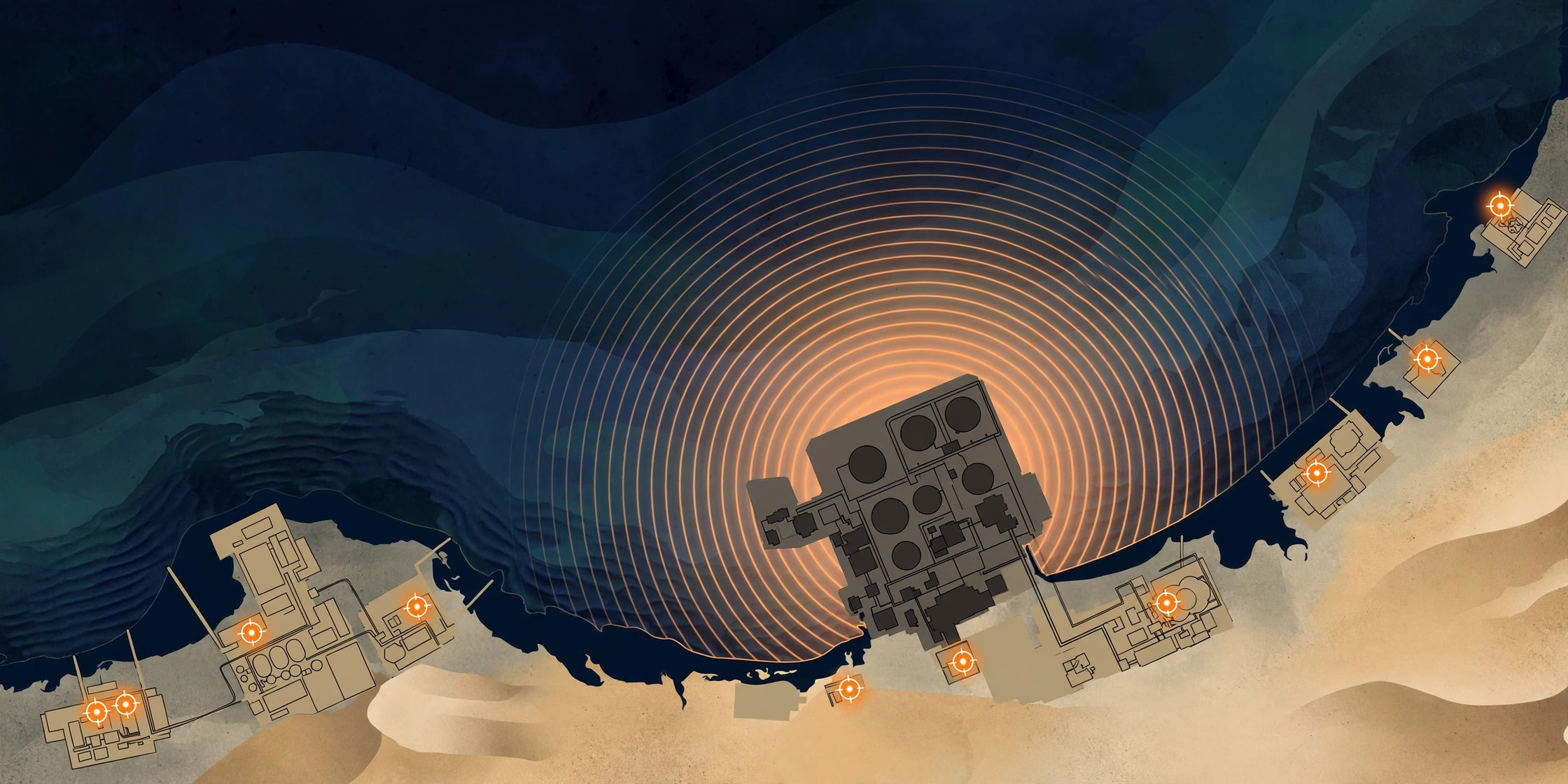
Reuters published a visual investigation on October 15 documenting how Iran and its allies have systematically struck civilian infrastructure across the Persian Gulf since the war began on February 28 — and concluded the targeting was deliberate, not collateral damage.
The numbers are stark. Reuters counted at least 135 drone and missile strikes on at least 84 infrastructure sites across Saudi Arabia, the United Arab Emirates, Iraq, Qatar, Kuwait, Oman, and Bahrain. The targets included water plants, power stations, airports, refineries, and what appears to be a nuclear power station. The investigation drew on 36 interviews, commercial and satellite imagery, and on-the-ground reporting.
The key finding is about precision. Again and again, munitions struck the single piece of equipment a facility could least afford to lose — components sometimes hidden under rooftops or only a few meters across. That pattern, Reuters concluded, rules out the official story that civilian damage was the side effect of stray or falling debris. The civilian infrastructure was the aim.
Kuwait illustrates the stakes most clearly. A desert country that draws roughly 90% of its drinking water from desalination plants, Kuwait saw at least four of its eight dual power-and-desalination facilities hit between March 2 and July 20, some of them repeatedly. The Al Subiya plant, which produces about one-fifth of Kuwait's drinking water, suffered what one expert described as extensive damage in a July 18 attack. Michael Christopher Low, director of the Middle East Center at the University of Utah, told Reuters that Kuwait lacks the natural water resources to survive without desalination: knock out enough capacity, and the country could face a water emergency within days or weeks. Kuwait's government responded with a public campaign urging citizens to conserve electricity and water "in the spirit of shared responsibility."
Airports were hit repeatedly too — in Bahrain, Kuwait, the UAE, and Saudi Arabia. Kuwait International Airport was struck eight times, including once just two days after a major terminal had reopened following repairs. The deadliest single attack identified in the investigation came on October 10 at Riyadh's King Khalid International Airport, where at least 13 people were killed. The Iran-backed Houthis claimed responsibility for that strike.
Bahrain's government called the deliberate targeting of facilities that communities rely on for power, water, travel, and livelihoods "a clear violation of international law." The economic shock waves are global: after attacks on a UAE aluminum smelter and a smelter in Bahrain the same weekend, the global price of aluminum climbed 5% to a four-year high.
This investigation changes the framing of the war's economic front. Until now, damage to Gulf infrastructure was often described in the fog-of-war terms that both sides use: accidents, debris, unverifiable claims. Reuters' satellite-verified strike-by-strike accounting makes the pattern visible and testable — and the pattern points to a deliberate campaign against the civilian systems that make modern Gulf states function.
The vulnerability it exposes is structural. Saudi Arabia, the Gulf's largest petrostate, produces roughly 10% of the world's crude oil, and nearly all of its exports flow through two main ports — Ras Tanura on the Gulf and King Fahd Industrial Port at Yanbu on the Red Sea. Oil and gas exports work as a system: wells, pipelines, refineries, ports. As a 1983 CIA report flagged decades ago, that web offers an almost inexhaustible number of targets. Reuters' investigation is, in effect, a demonstration of that old assessment in real time.
It also complicates the U.S. war effort. The investigation's title framing — precision strikes "blunting US war plans" — reflects how the campaign constrains American options: every Gulf facility degraded is a facility Washington's allies need functioning, and every strike on desalination or power tests whether the coalition of Gulf states can sustain a long war whose costs keep landing on civilian infrastructure.
For the energy markets, the message is that this war has a permanent price built into it. When a single weekend of smelter strikes pushes aluminum to a four-year high, and when shipping and refinery capacity across the Gulf operates under recurring threat, the risk premium doesn't go away between headlines.
The investigation does not settle responsibility for every strike it counts — Reuters attributes the pattern to "Iran and its allies," and the strikes continue to be claimed, denied, and disputed in turn. What it does establish is a verified baseline: more than 130 strikes on more than 80 sites, documented with imagery and testimony, against systems civilians depend on.
Expect three things. First, legal and diplomatic pressure will build on the evidence of deliberate civilian targeting, with states like Bahrain already invoking international law. Second, Gulf states will accelerate hardening of critical infrastructure — desalination plants, grid nodes, and airport perimeters that were designed for accidents, not precision drone campaigns. Third, watch the markets: any expansion of strikes on energy and metals infrastructure will move prices well beyond the region, as the aluminum spike showed.
The investigation also raises the stakes of any negotiation. Reuters noted that as recently as October 12, Iran was reviewing an American response to proposals about the Strait of Hormuz — a reminder that diplomacy continues even as the strikes do.