 What's trending, explained.
What's trending, explained.
What's trending, explained.
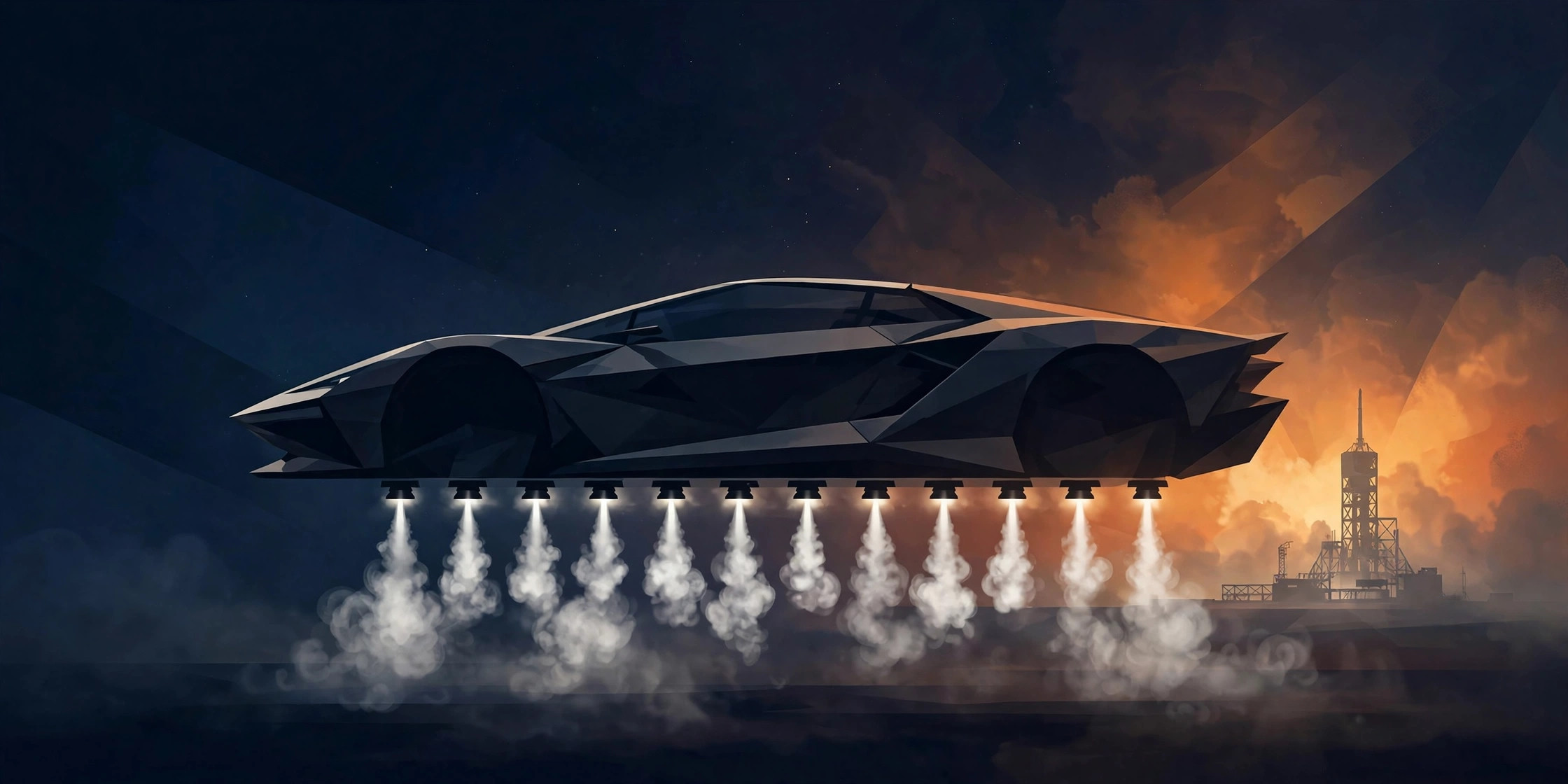
On Thursday, October 15, 2026, Tesla finally showed off its long-delayed second-generation Roadster at an outdoor event near SpaceX's test facility in McGregor, Texas, just outside Waco. The livestream began at 7:55 p.m. local time (8:55 p.m. ET). Elon Musk, joined by design lead Franz von Holzhausen and engineering VP Lars Moravy, called it a "better than James Bond car" and the product of "a collaboration with the world's best car company and the world's best rocket company."
The demonstration leaned hard into the spectacle Musk had promised — he had earlier called it a candidate for the "greatest product demo of all time." The car used a mixture of high-powered fans and cold-gas thrusters to drive up an inverted ramp, spin in mid-air, and ease itself back down to the pavement. It also lifted itself over a row of other Teslas — a Cybercab, Cybertruck, Tesla Semi, Model Y, and Model 3 — while in motion. The car demonstrated an acceleration run clocked at around one second from 0 to 60 mph, though the timing method was not independently verified. Musk said of the sub-one-second figure: "that is least interesting part."
The event itself had already been postponed once: Tesla originally planned it for October 1, then pushed it to October 15, citing severe weather forecasts in central Texas and the fact that the demonstration could only be staged outdoors.
This is the car Tesla has been promising for almost a decade. Musk first unveiled the next-generation Roadster concept in November 2017, with production originally targeted for 2020. It has missed every delivery target since — the 2026 demo was postponed six times this year alone, per coverage of the run-up. Tesla recently reopened reservations with $50,000 deposits from buyers in the U.S., Canada, and China, so this reveal doubles as a credibility test with customers who have been waiting for years.
The technical claims are genuinely unusual for a road car. Tesla said the Roadster will come in three trims: "Performance" (road ready, seats two, active aerodynamics, multi-mode suction system), "Thrust" (race ready, seats two, rear-mounted cold-gas thrusters enabling the sub-one-second sprint), and "Rocket" (air ready, seats one, ten cold-gas thrusters positioned around the car). Engineering VP Lars Moravy said the car uses ten thrusters connected to 600 liters of compressed air, stored in carbon-fiber pressure vessels packed into "every usable void" in the vehicle — the same type of vessels used in SpaceX rockets. All three trims are claimed to have 300 miles of range and a top speed above 230 mph. Tesla did not name a final price.
Investors, however, are likely to treat this as theater rather than a business event. Coverage heading into the reveal noted Tesla shares weakening rather than rallying, and analysts widely describe the Roadster as a low-volume halo car with no material impact on Tesla's finances — the company delivers hundreds of thousands of mainstream vehicles a quarter, and the Roadster is aimed at a handful of wealthy enthusiasts.
Tesla now says it will finally build the Roadster in 2028 — a year or more after the reveal, assuming no further delays. Whether a production car can actually deliver hovering maneuvers, sub-one-second acceleration, and a 230+ mph top speed while meeting road-safety standards is the open question; regulators, insurers, and safety advocates are unlikely to have a settled view on thruster-assisted driving any time soon.
Watch for Tesla's third-quarter results on October 21, which will show whether the company's core business — 486,532 vehicle deliveries in the quarter — is healthy enough that the Roadster can be treated as a brand statement rather than a distraction. And watch the reservations: Tesla has reopened $50,000 deposits, so real demand, not demo spectacle, will decide whether this becomes a product or just the most expensive publicity stunt in car history.